
Sustainability as a Business Strategy
What if sustainability wasn’t another cost to your business, but one of the best ways to reduce costs and prepare for the future?
For many small and medium sized businesses (SMEs), sustainability can feel like just another thing on an already full to do list. It’s often seen as something that’s expensive, time consuming or only relevant to larger organisations with dedicated sustainability teams.
However, the reality is changing.
Like many businesses across Ireland and the UK, SMEs have faced rising energy prices, inflation, higher wage bills and increasing operating costs over recent years. At the same time, customers, investors and supply chains are placing greater emphasis on sustainability, while new regulations continue to emerge.
For SMEs, sustainability is no longer just about protecting the environment. It’s becoming an important part of running an efficient, resilient and competitive business.
Sustainability is about being prepared
Future proofing your business means being prepared for change.
No one can predict exactly what the next few years will bring, however businesses that understand how they use energy, materials and resources are in a much stronger position to respond.
Whether it’s another rise in electricity prices, supply chain disruption, changing customer expectations or new reporting requirements, understanding your business today will help you make better decisions tomorrow.
Rather than reacting to challenges as they arise, businesses can take practical steps now that reduce costs, improve efficiency and strengthen resilience for the future.
Start with the data you already have
One of the biggest misconceptions about sustainability is that it requires major investment. In reality, many of the biggest opportunities come from simply understanding your business better.
Most SMEs are already collecting valuable information without realising it. Energy bills, fuel receipts, waste collection invoices and purchasing records all provide useful insights into where money is being spent.
Ask yourself:
- Where is energy being wasted?
- Are unnecessary journeys increasing fuel costs?
- Could waste be reduced?
- Are there processes that take longer or use more resources than they need to?
Using this information to make informed decisions often delivers quicker returns than investing in expensive new technologies.
In our experience through the E-DATA project, the businesses making the greatest progress are rarely the ones spending the most money. They are the ones using data to identify practical opportunities and making small improvements over time.
We have seen businesses identify simple changes that have delivered real savings. One SME found that reviewing their heating schedule and replacing older lighting significantly reduced their electricity consumption. Another realised they were paying for more waste collections than they actually needed, reducing both costs and waste. Neither required a major investment, just a closer look at the data they already had.
Sustainability is becoming part of doing business
If you’ve applied for a contract recently, you may have noticed more questions about sustainability. Increasingly, buyers want to understand how suppliers are managing their environmental impact. Sustainability policies, carbon reduction plans and environmental management are becoming more common within tenders and supplier questionnaires.
You don’t need to have every answer today but understanding where your business stands will put you in a much stronger position when these questions arise.
Good for the environment and good for business
Many businesses begin looking at sustainability because they want to reduce their environmental impact. What often surprises them are the wider business benefits.
Reducing energy use lowers bills. Cutting waste can reduce disposal costs. Reviewing business travel can reduce fuel costs. Improving processes often saves both time and money.
Take something as simple as heating and lighting, adjusting heating schedules, switching off equipment when it’s not in use or replacing older lighting with LED alternatives can all reduce energy consumption with relatively little investment. Similarly, reviewing waste collections or delivery routes can often identify savings that have little or no impact on day-to-day operations.
These improvements don’t just reduce environmental impact. They make businesses more efficient, more resilient and often more profitable.
Small steps make a big difference
One thing we’ve consistently seen through the E-DATA project is that most SMEs are already doing more than they realise.
Whether it’s reducing waste, improving efficiency, cutting packaging or finding ways to lower energy use, many businesses have already started their sustainability journey. They just haven’t labelled it as sustainability.
There is no single route to becoming a more sustainable business, and you don’t have to do everything at once. The most successful businesses start by understanding where they are today, identifying a few practical improvements and building on those successes over time.
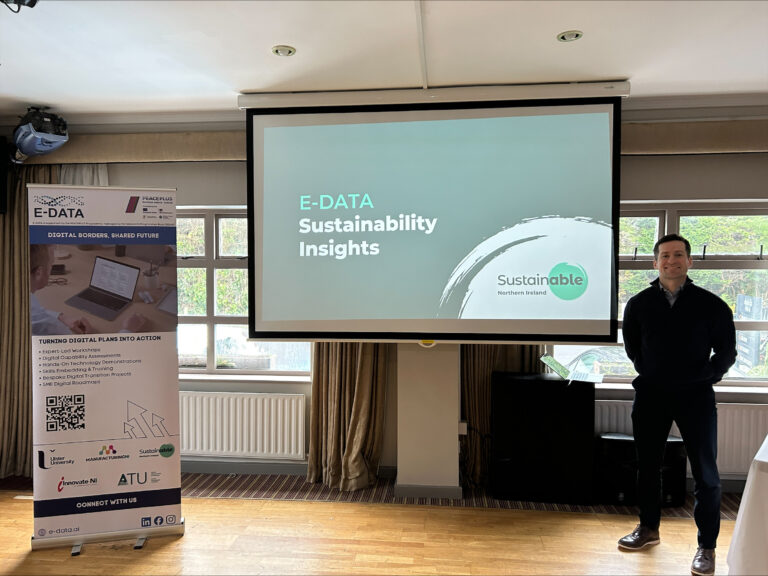
This is where the E-DATA project comes in. Through E-DATA, Sustainable NI is helping SMEs across Northern Ireland turn business data into practical action. From interactive dashboards and benchmarking tools, to workshops, one to one mentoring and tailored interventions, businesses can access the support they need to better understand their environmental performance, identify opportunities to reduce costs and improve efficiency and develop practical actions that work for their business.
Rather than relying on guesswork, E-DATA helps businesses use the information they already have to make informed decisions. Whether that’s reducing energy use, improving resource efficiency, lowering costs or preparing for future customer and supply chain expectations, the aim is to help businesses focus on actions that deliver real value.
Sustainability doesn’t have to be complicated. It starts with understanding your business, using data to make better decisions and taking one practical step at a time. Those small steps can strengthen your business today and help prepare it for the opportunities and challenges of tomorrow.
Our next Positive Carbon Reduction workshop will take place online on the 26th August 2026, from 12pm to 1pm.
You can register here: E-DATA Positive Carbon Reduction – Online – E-DATA